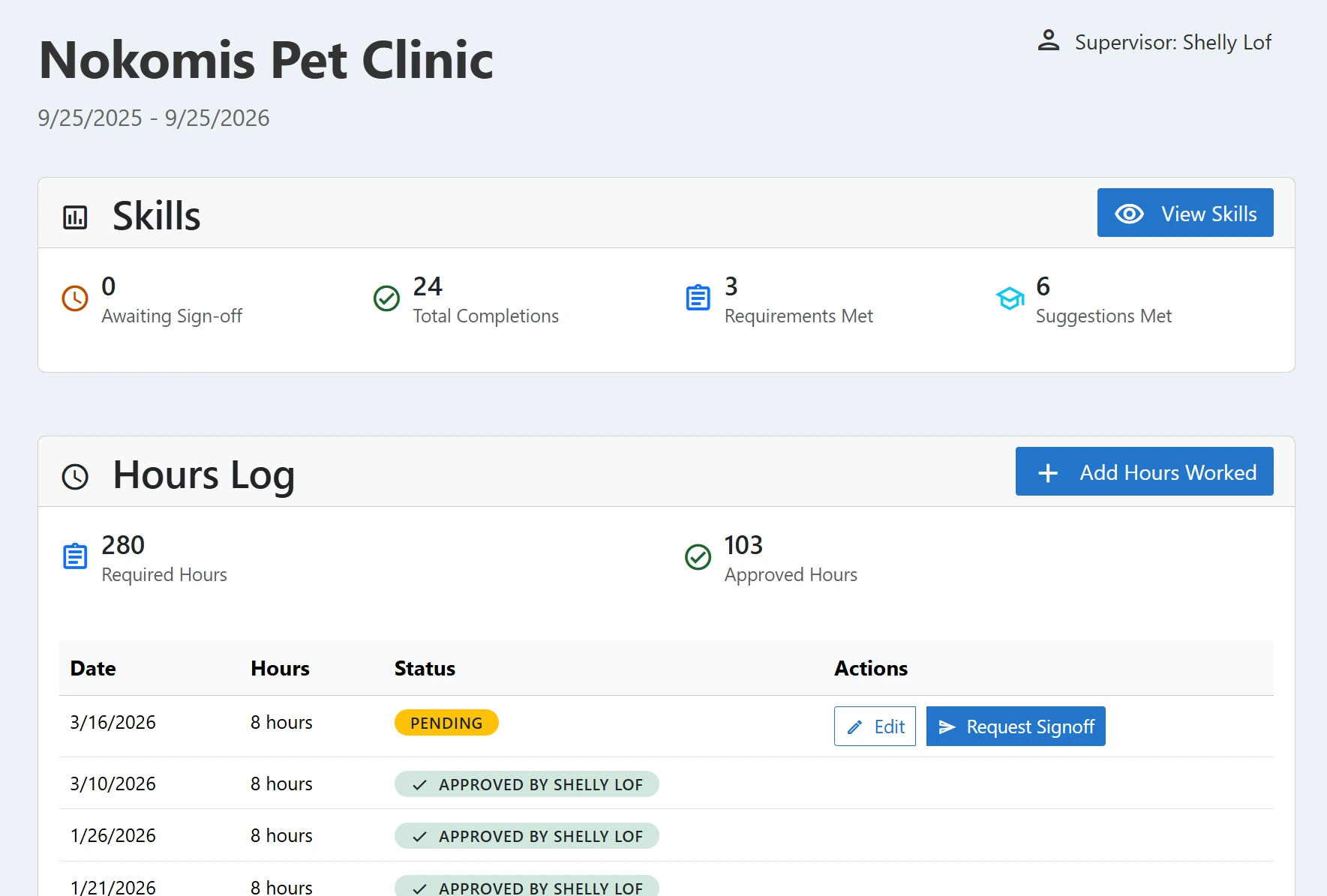
Track clinical hours clearly
Most programs begin by tracking student hours spent in clinical environments. Salt House allows students to log their time at internship sites so programs maintain a clear record of clinical experience. Faculty and administrators can review accumulated hours and ensure students are meeting program requirements.
This replaces paper logs or spreadsheets with a centralized record that remains accessible throughout the program.
Supervisor verification without extra complexity
Clinical supervisors are often busy veterinary professionals. Asking them to learn a new platform or create an account can create unnecessary friction.
Salt House allows supervisors to confirm student hours through a simple approval interface that requires no account setup. The process is designed to be quick and straightforward so verification can happen easily while maintaining clear documentation for the program.
A built-in directory of internship sites
Programs often maintain information about clinical placement sites as part of coordinating internships. Salt House turns that information into a useful resource for students.
Students can browse a directory of approved or previously used sites, review details about each location, and identify potential internship opportunities. Much of this information is already captured when programs manage internships, so the directory becomes an additional benefit without requiring extra administrative work.
Flexible skill tracking during internships
Different veterinary technician programs approach clinical skill tracking in different ways. Some schools simply document hours, while others use internships to guide student exposure to specific tasks.
Salt House allows programs to add skill tracking when desired. These skills may be used as guidance for students, as required tasks for a rotation, or as custom competencies defined by the program.
In some cases, programs also use clinical rotations to support completion of CVTEA-required competencies when those skills cannot be performed on campus. While this approach requires careful program design to remain consistent with CVTEA expectations, Salt House can support those workflows when needed.
Supporting real clinical learning
Internships connect students with the realities of veterinary practice. By tracking hours, simplifying supervisor verification, and providing optional guidance on clinical skills, Salt House helps programs manage these experiences while maintaining clear documentation of student progress.
The result is a practical system that supports both program administration and meaningful clinical learning.